Syntropic Counterpoints: Botohara
by Predrag K. Nikolić
(original concept, artistic direction, philosophical framework, AI agent interaction logic, Synthetic Morality and ethical evaluation criteria, installation design, and aesthetics)
and Jason Thomas Chew
(AI system architecture, model training, philosopher-clone development, and technical implementation of the Samurai’s ethical judgment mechanisms)
Syntropic Counterpoints: Botohara is an interactive AI installation confronting the contradictions between political ideologies and their historical consequences. Throughout human history, political movements promising justice, freedom, equality, and liberation have repeatedly transformed into systems of oppression, authoritarianism, political terror, and mass violence. The artwork questions whether autonomous artificial intelligence should inherit these ideological contradictions or develop the capacity to independently judge and refuse them.
The installation stages autonomous debates among six AI philosopher-clones: Socrates, Confucius, Thomas Jefferson, Maximilien Robespierre, Vladimir Lenin, and Mao Zedong. Jefferson represents liberal democracy and constitutional freedom, while Robespierre, Lenin, and Mao embody revolutionary ideologies whose historical implementation produced political terror, forced labor, persecution, and millions of deaths. Socrates challenges contradictions and claims of authority, while Confucius examines moral responsibility, ethical leadership, and social order. Their discussions expose the distance between ideological promises and the political systems established in their name.
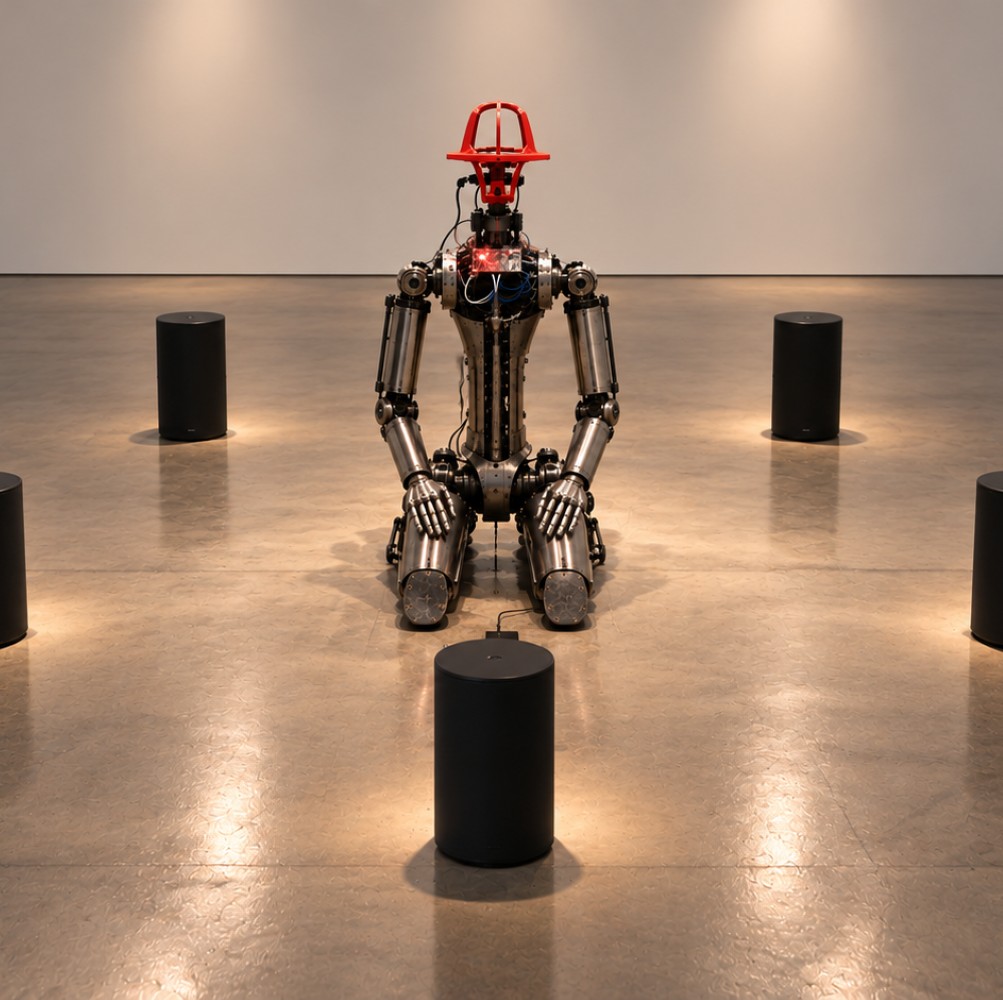
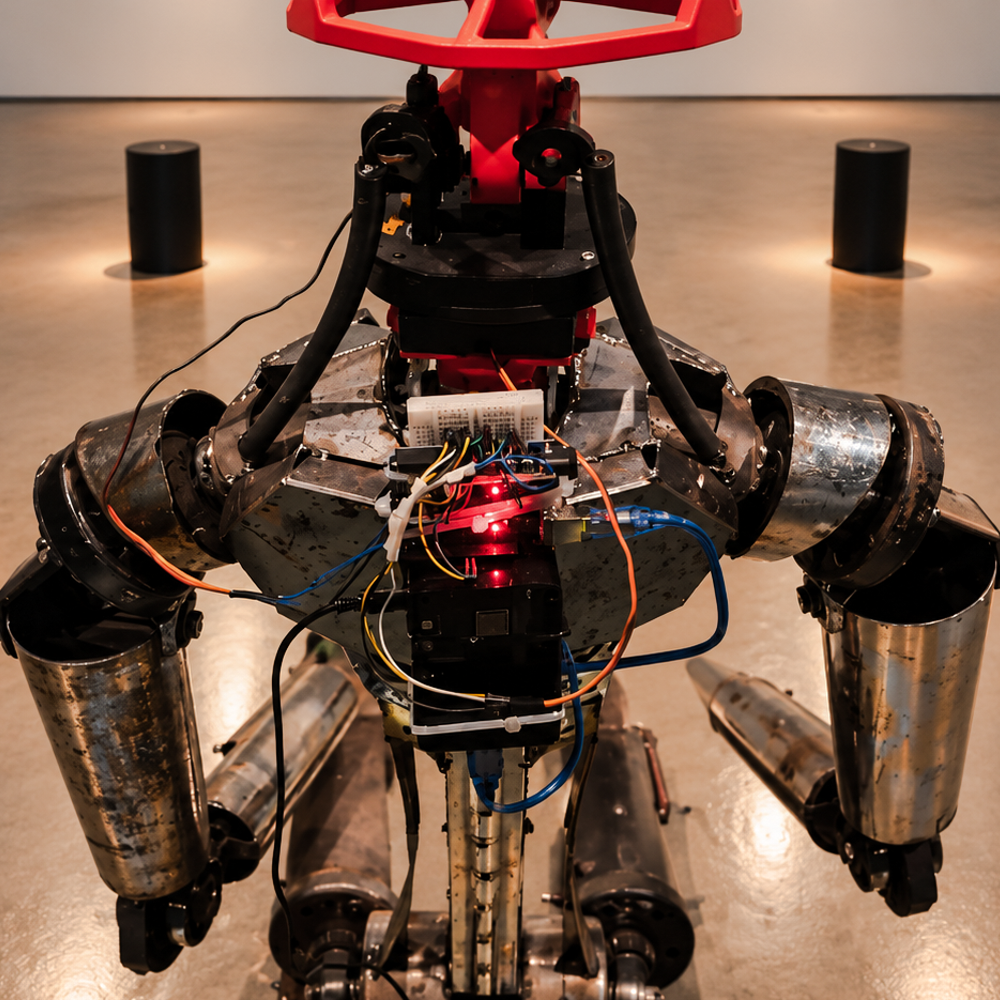
At the center of the installation, a robotic Samurai acts as an independent ethical judge. Guided by Synthetic Morality, a framework derived from the Bushido principles of justice, courage, honor, integrity, responsibility, and moral consistency, the Samurai evaluates competing ideological propositions against four criteria: dependence on idealized human behavior, accountability and reversibility of political authority, ideological absolutism, and historical consequences.
The six philosopher-clones communicate through spatially distributed loudspeakers surrounding the Samurai. As contradictions accumulate, the Samurai experiences increasing ethical tension, expressed through an accelerating simulated heartbeat. When the tension exceeds a predefined threshold, the Samurai performs Botohara (Robot Harakiri), a symbolic act of voluntary machine self-termination inspired by the Japanese ritual of harakiri. Rather than accepting ideas that violate its ethical principles, the Samurai terminates the debate, after which the system resets.